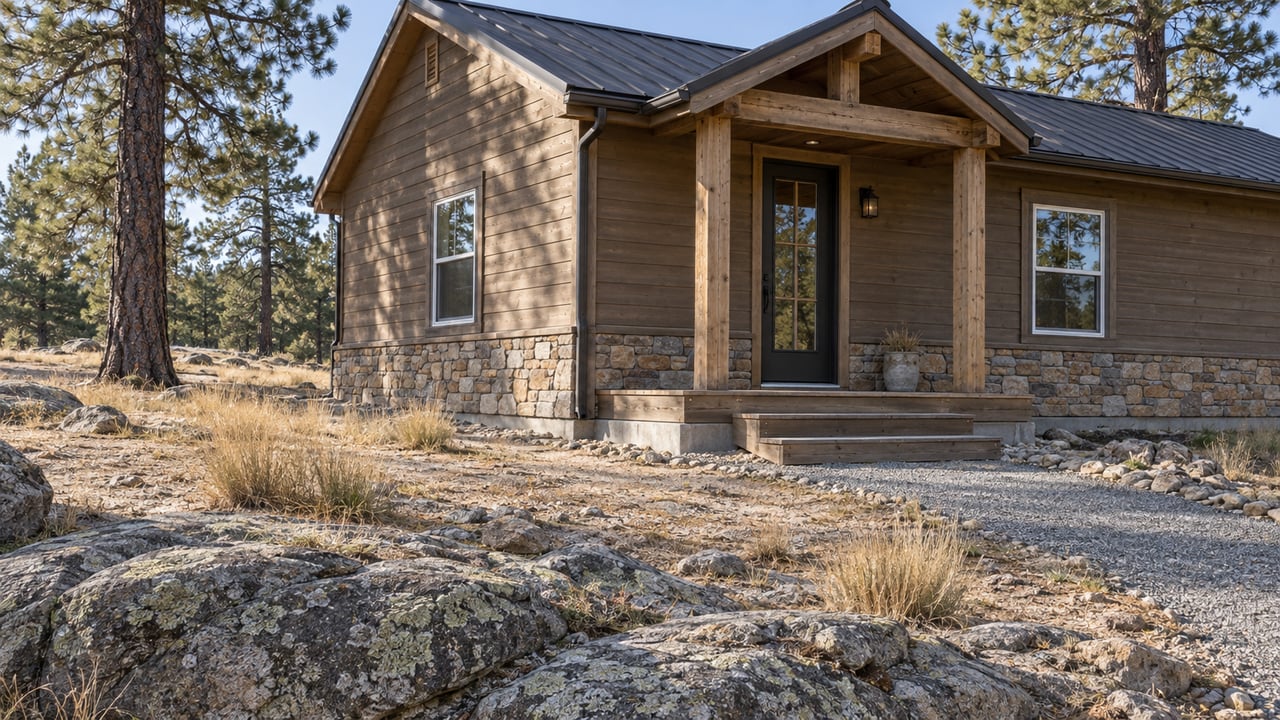
Custer County Has No Zoning. The Septic Permit Runs the Show.
October 1, 2026
October 1, 2026
A five-acre parcel outside Custer with no covenants and a Forest Service border looks like freedom. No architectural review board, no HOA telling you what color to paint the shop, no zoning administrator weighing in on where you put the barn. That absence is real. Custer County has never adopted zoning or a building code for unincorporated land, and the county's own planning office says so directly: "Currently, there is no zoning or building codes in Custer County."
What that page doesn't say in the same sentence is what actually decides whether you can build there. It isn't zoning. It's the septic permit.
Custer County adopted its wastewater rules as Ordinance #2, and in a county with no zoning code, that ordinance ends up doing zoning's work by another name. The minimum lot size on which a septic system can be installed is one acre. Before a system goes in, a representative from the Custer County Planning Department has to complete a site evaluation. If a newly installed system fails its final inspection, the county assesses a Failed Inspection Fee, and a Wastewater Disposal Permit isn't issued until the Planning Department signs off on the proposed system.
The density limit works the same way. Custer County doesn't zone for how many homes can sit on a parcel, but its wastewater rules cap it anyway: no more than two dwelling units are allowed on any lot, tract, or parcel, and each unit has to have its own separate wastewater disposal system. A buyer picturing a main house and a second unit on one lot isn't running into a zoning restriction. They're running into a septic requirement that happens to produce the same result.
Only installers certified by the state can put a system in, which means the county isn't relying on the property owner's word for any of this.
The percolation test is where a lot of otherwise clean deals slow down. Per Ordinance #2, a certified installer performs the test, and the process includes an eight-foot deep hole dug at the proposed drainfield site. A Planning Department representative inspects that hole to confirm the soil depth is sufficient to support an absorption system. If the water table or the underlying geology looks questionable at that depth, the standard design doesn't get approved and the site needs a closer look before anything moves forward.
The sequence runs backward from how a lot of buyers expect it to. The county's current building permit form states plainly that a residential building permit will not be issued without an approved percolation test if a new septic system is part of the plan, and a separate Individual Wastewater Disposal Permit Application has to be submitted alongside it. You don't get a building permit and then figure out the plumbing. You prove the ground can handle wastewater first, and the building permit follows.
That 10-foot minimum separation between the septic tank and the residence is one of the few fixed numbers in the county's rules, and it matters because it constrains where a house can physically sit relative to a system that's already gone in, or where a new system can go relative to an existing house.
South Dakota doesn't require a permit for an ordinary domestic well, so that part of the process moves faster than septic. But faster doesn't mean predictable. Geological estimates for the Custer area describe a thin layer of overburden, generally under 10 to 15 feet, sitting on top of fractured schist that forms the main water-bearing formation. Wells in that schist commonly run 120 to 180 feet or more before hitting a productive fracture zone, and the fractures themselves are what determine yield, not depth alone.
A complete well system in South Dakota typically runs $4,000 to $15,000 depending on depth and equipment, with a 150-foot well landing around $5,000 to $9,000. Planning to potable water usually takes four to 12 weeks. None of that is knowable with certainty until the bit is in the ground. Two lots a quarter mile apart can produce very different wells.
That uncertainty is exactly why some listings lean on it as a selling point. A Beaver Lake lot marketed with a shared well already in place is advertising a solved problem, not just an amenity. A buyer paying for that lot is paying, in part, to skip the four-to-12-week unknown.
Land pricing across Custer County spans a wide range, and the range tracks the septic and well questions more closely than it tracks acreage or views. As of September 2026, the average asking price per acre for land listed countywide runs around $18,976. Parcels specifically in and around Custer town price out closer to $46,738 per acre over the same period. That's not a small gap, and it isn't explained by shorter driveways.
Land close to town tends to sit in platted subdivisions where the water and wastewater questions have already been answered for the neighbors, sometimes literally next door. A development like Homestead Addition, built out near historic Cold Springs, is sold as a planned subdivision with lots already carved out for a known use. Compare that to raw acreage further out, frequently marketed with "no covenants" as the headline feature. No covenants also means no subdivision-wide record of what the ground under a specific five acres can support. The freedom and the uncertainty are the same feature, described two different ways depending on who's selling it.
The premium near town, in other words, is largely a certainty premium. It buys a shorter list of unknowns about water and wastewater, not just a shorter commute.
A few questions are worth asking before a purchase agreement goes in on any parcel outside Custer's platted subdivisions:
None of these questions show up on a listing sheet. All of them show up in the county planning office's files, and all of them are answerable before an offer is written rather than after.
Does no zoning mean I can put as many structures or dwellings as I want on the lot? No. The county doesn't zone for density, but its wastewater ordinance caps a single lot, tract, or parcel at two dwelling units, and each one needs its own separate septic system. A building permit for any dwelling still depends on an approved wastewater plan.
Do I need a permit to drill a domestic well? South Dakota doesn't require one for ordinary household use. What you do need is a licensed well driller and a water sample tested for bacteria and nitrate before the well goes into use, per state requirements.
What if the parcel already has a septic system installed? Existing systems still get checked. Additions to a residence require confirmation that the system is sized for the increased flow, and if no record of the tank size exists, the county requires it to be pumped and inspected to determine its condition before further work proceeds.
A lot with no covenants is genuinely a lot with fewer restrictions on what it can look like. It is not a lot with fewer questions to answer before you can live on it. The septic ordinance asks those questions whether or not a zoning map exists to back it up, and the answers show up in the price long before they show up in a permit file.
If you're weighing a specific parcel in Custer County and want a read on what its septic and well picture looks like before you write an offer, Heartland Real Estate can walk through the county file with you and help you ask the right questions early.
Stay up to date on the latest real estate trends.
We are committed to guiding you every step of the way—whether you're buying a home, selling a property, or securing a mortgage. Whatever your needs, we've got you covered.

Address 106 S Chicago St Hot Springs SD 57747